Be yourself; Everyone else is already taken.
— Oscar Wilde.
This is the first post on my new blog. I’m just getting this new blog going, so stay tuned for more. Subscribe below to get notified when I post new updates.
Event Response Assignment:
International Women’s Day at the YWCA
Kelsie McGee
For the second event of the semester, I chose to attend the International Women’s Day celebration at the local YWCA in High Point. There were a wide array of cultures, traditions, and forms of art that were packed together in one small room, immediately upon entering you could hear the sounds of latin music, enjoy smells from food that was prepared from recipes around the world and listen to good conversation happening all around. There were several different beautiful performances that occurred throughout the celebration, all paying homage to their respective culture
There were a few particular moments throughout the night that really sparked my attention, one of my favorites being the wonderful traditional dishes that were prepared from the Indian, Latin American, and African cultures. I thought the authentic food really brought the entire experience full circle from the music, to the performances. Another small aspect of the event that I found interesting were the amazing Native American jewelries that had been handmade, each piece of jewelry was unique and authentic to the Native American culture. However, my favorite part of the night by far were the performances by the groups of girls, my favorite two being the Vinmark International Dancers and the Mexican Folklore performances. The Vinmark group’s catchphrase is “embracing diversity through dance” and I could really feel that throughout their performance. The most memorable part of the Mexican Folklore dance were the beautiful traditional dresses, hairstyles and makeup, it was really amazing to experience the Mexican culture in a genuine atmosphere.
Considering we have been discussing women and the roles they play in their cultures from around the world, I saw many different aspects that related back to what we have been learning in the course. After reading the novel “Under the Udala Trees” in class, the story about a young girl, feeling oppressed and growing up in Nigeria, watching the documentary of the girls in India, and reading the segment from “The Treatment of Bibi Haldar”, it made me reflect on the importance that women here in the United States embrace their cultures and feel accepted with open arms by those around them. We have seen how women around the world can be treated very poorly for expressing themselves, so I felt it was awesome these women could share their culture in such a modern, open way.
For me, the biggest takeaway from attending this event ties in perfectly with their slogan of “An equal world is an enabled world”. When we all have the same opportunities for success as women all around the world, we can find the ability to help one another rise up and build to be the best version of themselves, free of oppression. There were many types of diverse people, including men, all attending this event for the same purpose; to eliminate racism and empower women around the world. This experience really inspired me to keep advocating and gave me hope to see a brighter future with individuals who really do have societies best interest at hand, fighting in efforts to see a truly equal and enabled world.
I saw this trailer for a documentary series that is set to come out this March while researching for articles about women’s rights around the world, and this video really stood out to me. I thought it really related to the topics we have been discussing in class such as LGBT issues in Nigeria, and women’s fundamental rights issues in India and the surrounding area that we are currently discussing. It is really impactful to me because it showcases these issues all over the world, not just in one spot and I am really excited to watch it when it releases!
I attended the play performed by the HPU Theatre department “Borrowed Babies”, the play was based in the years 1952 and 1982 and displayed the lives of a female professor, Mrs. L, 4 female students, and an orphan child named Katherine that they cared for as a part of their home economics course credit during the 1950’s. Later in life, when the orphan child is an adult herself, and the professor is being forced to leave the office she has had for all these years, the two meet again after Katherine searched for Mrs. L for years after seeing her name on a letter she found in her belongings at the foster care center. Eventually the two meet under what seem to be unwelcome circumstances from Mrs. L until she realizes that the woman that barged into her office is Katherine. For the duration of the play, we see the students caring for Katherine as a baby and learning new and valuable information about domestic life and the harsh reality of the oppression of women in the 1950’s, while at the same time we are hearing about the memories the family of women shared all those years ago when Katherine and Mrs. L met again in 1982. I wish I could say that the play ended on a positive note, but Katherine held a grudge against Mrs. L for not ensuring that she had made it into a loving home one leaving her care, and because of that she bounced around from home to home until she finally ran away. However, Mrs. L had a very old fashioned way of thinking, she hated the idea that women are no longer interested in learning to be a “domesticated housewife”, and would rather be a lawyer or scientist. At the end of the play we see the harsh reality that Mrs. L gave up her whole life to educating women on how to be women when now, in her eyes, no one cares about having those skill sets anymore. Katherine and Mrs. L clearly had very different opinions on this subject and at the end of the play the both of them are what they have been all along yet again, alone.
A few moments during the play that particularly caught my attention were the cultural differences in the way the 4 students acted during the 1950’s versus how Katherine and some of Mrs. L’s “current” students of the 80’s acted in terms of the way they talked about relationships, responsibilities, the clothes they wore, and even the way they thought and spoke about women’s rights. It was also interesting to see how Katherine thought what they did with her as a child was similar to a class project or just a grade, and Mrs. L saw it as much more of a family considering she had no one else in her life at the time. I can definitely see how some of the aspects of the play relate to what we have been doing in class relating to women’s rights around the world versus women’s rights in the west. This is a great example about how women in America were fighting for things like equality in the school system, gender roles, and domestic oppression from fathers and husbands, where as in class we have been learning about many different form of women’s oppression such as the right to choose who you love, or if you are allowed to get an education or not. Mrs. L reminded me a lot of the women in the short story “The Treatment of Bibi Haldar” by Jhumpa Lahiri that were only teaching Bibi how to a good woman, not all the other necessary things a person might need to learn, only the womanly things. I feel that the big picture that this play is trying to get at are the many different aspects of a woman’s lives and the different views and struggles that different women faced back then and how they are changing over time. Something that will stick with me from the play is the hard, oppressive decisions the young, female students from the 50’s had to make to please their families and the social norms of the times.
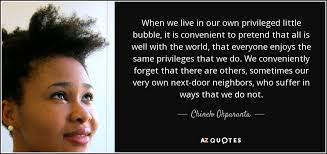
This is a quote from Okparanta, the author of the novel “Under the Udala Trees” we read in class. This quote really reminded me of the conversation we had in class about being blind to the reality of the lives of other women around the world, so often we do not see what is really going on behind the scenes of someones life. This also reminded me of Ijeoma, the main character of the novel, and how she was forced to conceal such a large part of her identity, and how she had to live in fear because of her sexuality. Living in the world today it can be easy to forget just how devastation the harsh realities of discrimination and prejudice that so many have to deal with for their whole lives. We can often not realize that even the people closest to us can be silently suffering.
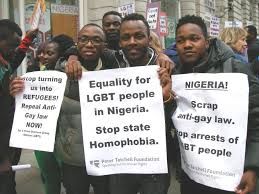
After watching the video with Okparanta concerning LGBT rights being taken away in Nigeria, hearing her opinions on the reasoning for the hate against the LGBT community when for some time in the country’s history it was never an issue really resonated with me. Colonization took so much away from African culture so I was not surprised to hear that her theory behind the increase in homophobia was due to the colonization and missionary work done in Nigeria over the years. It truly saddens me that there are so many innocent members of the LGBT community that now have to live life in fear or behind closed doors because of the new law criminalizing homosexuality.
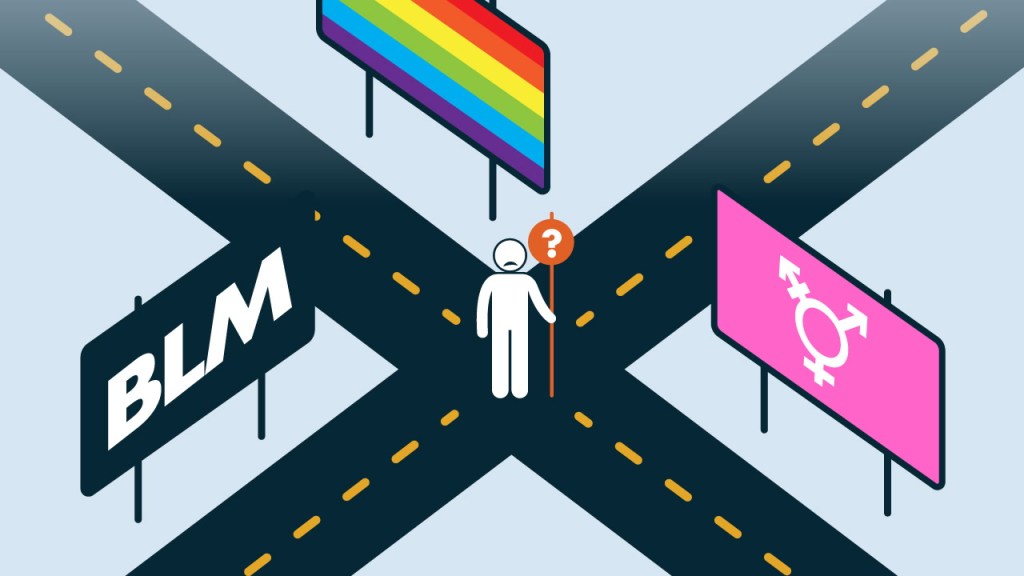
This picture refers to the way Crenshaw describes intersectionality as a multitude of cross roads that could represent your race, class, gender, sexual orientation or other things, and the traffic that goes through these roads is seen as the policies and practices society uses that might leave out, or not take into consideration multiple facets of someones identity. After learning in class that women of color are the real face of intersectionality due to the many different sources of discrimination they can potentially face, I feel that it is more important now than ever for social justice activists and political systems to start taking into account these different identities and how they can effect women of color in their daily lives.
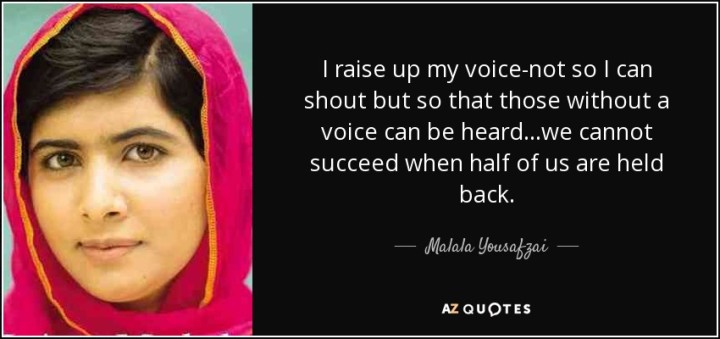
In class we spoke about the responsibility we sometimes feel to speak up on behalf of the women across the world that are still experiencing horrible and harsh living conditions, and the reasoning in some cases is simply because they are a woman. We also need to realize that our perspective of equal and just, might not be the same to other woman in different parts of the world. Still, it is important for those of us with the privilege to do so, to fight for women everywhere to have the freedom that they seek to have, not the freedom that we may seek for ourselves. It is important to educate yourself first, and then later speak on behalf of the women who cannot.
This is an example post, originally published as part of Blogging University. Enroll in one of our ten programs, and start your blog right.
You’re going to publish a post today. Don’t worry about how your blog looks. Don’t worry if you haven’t given it a name yet, or you’re feeling overwhelmed. Just click the “New Post” button, and tell us why you’re here.
Why do this?
The post can be short or long, a personal intro to your life or a bloggy mission statement, a manifesto for the future or a simple outline of your the types of things you hope to publish.
To help you get started, here are a few questions:
You’re not locked into any of this; one of the wonderful things about blogs is how they constantly evolve as we learn, grow, and interact with one another — but it’s good to know where and why you started, and articulating your goals may just give you a few other post ideas.
Can’t think how to get started? Just write the first thing that pops into your head. Anne Lamott, author of a book on writing we love, says that you need to give yourself permission to write a “crappy first draft”. Anne makes a great point — just start writing, and worry about editing it later.
When you’re ready to publish, give your post three to five tags that describe your blog’s focus — writing, photography, fiction, parenting, food, cars, movies, sports, whatever. These tags will help others who care about your topics find you in the Reader. Make sure one of the tags is “zerotohero,” so other new bloggers can find you, too.
Have a WordPress.com account? Log in now.

